
One Board for Humans and AI: How a Shared Task Queue Runs the Whole Team
We don't run our AI virtual employees in a separate app. They share one task board with our people, same columns, same cards, same red/yellow/green status. Here's how a single shared queue keeps humans and AI working as one team, in the open.
Most AI tools have the same blind spot: you can’t see them work. You type a request into a box, something happens behind a curtain, and an answer comes back. Was it thorough? Did it skip a step? Is it still working, or did it quietly give up three minutes ago? You don’t know. The work happens in the dark, and you’re left trusting an outcome you never watched get made.
That black box is fine for a one-off question. It is no way to run a team. The moment you have several AI workers handling real jobs, and people working alongside them, you need to see the whole floor: who’s on what, what’s waiting, what’s stuck, what’s finished and verified. Not a chat log. A floor.
So when we built our team of AI virtual employees, the specialist “Dog Pack” that triages our tickets, drafts our proposals, reviews our code, and researches our hard problems, we made a deliberate choice about where the work lives. Not in a separate AI portal nobody opens. On the same task board our people use, in the open, where humans and AI share one queue. This is a look at that board, and why a shared task queue turns out to be the thing that makes an AI workforce actually trustworthy.
One board, not an “AI app”
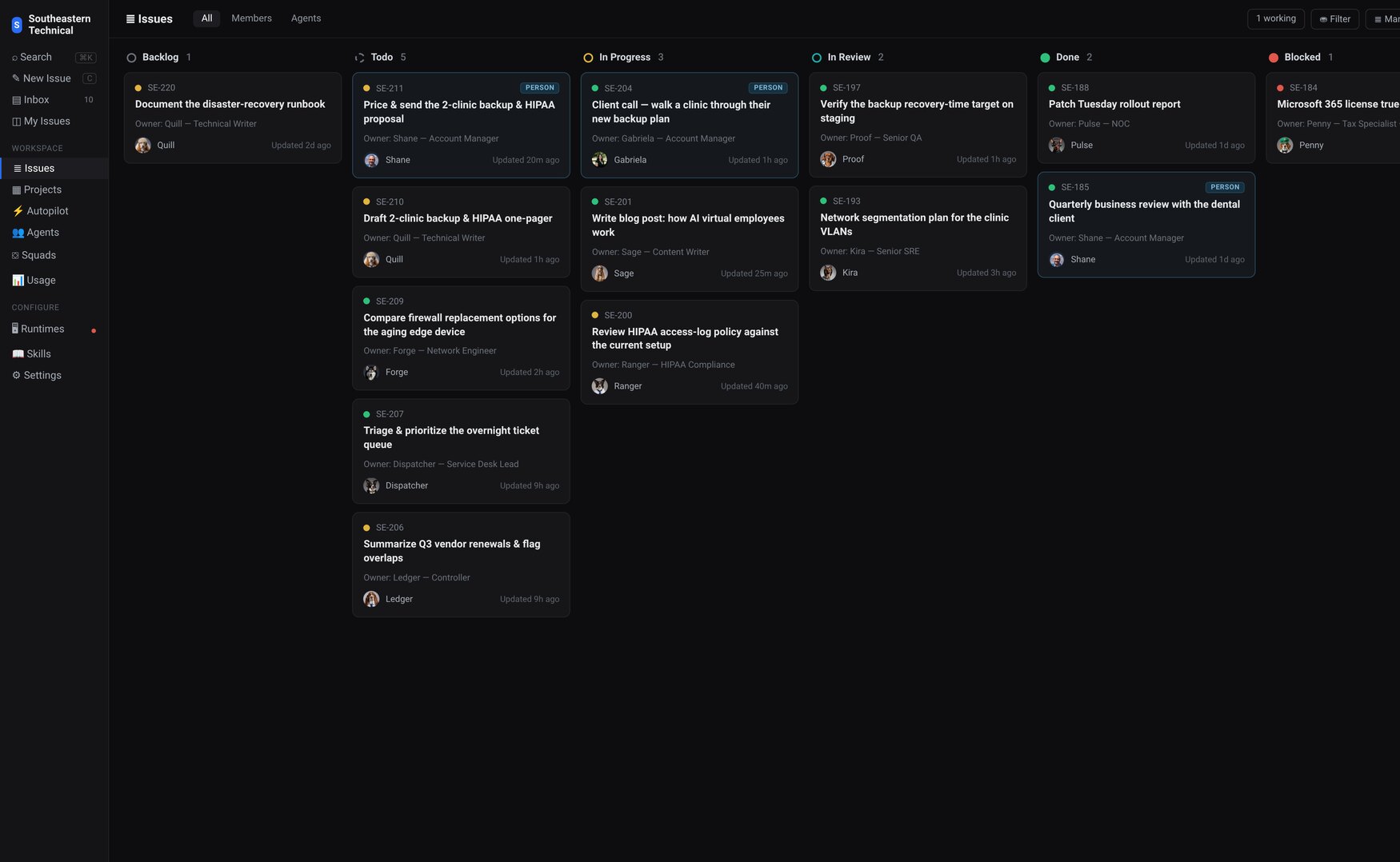
Walk past most teams and you’ll find a Kanban board somewhere, a wall of cards moving left to right across columns as work gets done. Ours looks ordinary at first glance. Columns run Backlog → Todo → In Progress → In Review → Done, with a Blocked lane off to the side for anything that’s stuck waiting on something. Every piece of work is a card. Every card has an owner and a status. You’ve seen the shape of it before.
Here’s the part that isn’t ordinary: roughly half the owners on that board aren’t people.
A card might belong to Aaron, one of our technicians. The next one down belongs to Forge, our network-engineer dog. The one under that is Quill, a writer, with a human reviewer’s name in the “In Review” column waiting to check it. Humans and AI virtual employees own cards on the same board, move them across the same columns, and hand work to each other in the same lanes. There is no separate “AI dashboard.” There’s one board, and the whole team, flesh and silicon, works from it.
That single design choice is the whole story: everything good about how our AI workforce runs comes from giving it no private workspace to hide in.
Why it’s a shared board, not a black box
We could have given the Dog Pack its own system and piped results back to people, plenty of AI products work exactly that way. We didn’t, for four concrete reasons.
You can see what every AI worker is doing, right now. Glance at the board and you know precisely what each virtual employee is working on, what’s queued behind it, and what it already finished. When a dog is grinding through a long research job, there’s a card sitting in “In Progress” with its name on it. The thing people fear most about AI, what is it actually doing back there?, simply isn’t a question you can ask about a worker whose every task is a visible card on a wall you’re already looking at.
Work flows both ways. This isn’t a board where humans assign and AI executes. A technician can hand a card straight to a dog, “research these three firewall options for me”, and walk away. And a dog can hand a card straight back to a person, “drafted the proposal; it needs a human to set pricing and approve.” The hand-off is just a card changing owners: no re-typing, no copy-paste between tools, no separate inbox. The work moves to whoever, or whatever, should hold it next.
Accountability happens in the open. Because every card carries an owner and a history, nothing is anonymous. You can always see which virtual employee did which piece of work, when it moved, and who reviewed it, the same accountability you’d want from a human team, applied to the AI ones, and only possible because they don’t get a private place to work where the trail goes cold.
Status is honest, at a glance. Every card carries a simple red / yellow / green flag, green is on track, yellow is slipping, red needs attention now. You don’t read a status report to find the trouble; the trouble is the red card, right there. Five seconds with the board tells you where the team is healthy and where something’s about to fall over, whether the owner of that card is a person or a dog.
Put those together and you get the thing a black box can never give you: an AI workforce you can actually supervise. Not trust on faith, watch.
How a day flows across the board
The best way to see it is to follow a single request as it crosses the columns.
It starts as a card. A request comes in, say a two-clinic medical practice wants to know how we’d protect their patient data and back everything up. It doesn’t sit in someone’s inbox until Thursday. It becomes a card in Todo the moment it lands, visible to the whole team.
The coordinator assigns it. Our pack has a coordinator named Chief who never does the hands-on work himself, his job is to size up each card and route it to the right specialist. He splits this one: the HIPAA-compliance dog takes the patient-data side, Forge sketches the backup setup, and a writer dog is queued to turn their notes into one clean page. Three cards, three owners, all moving into In Progress, and a human watches the whole assignment happen.
Cards move as the work gets done. The specialists pick up their cards, do the actual work, and slide them rightward. When one dog finishes its part, it hands its card to the next, the HIPAA notes flow to the writer; the writer’s draft flows toward review. The board updates itself as the work advances, so at any moment the picture is current without anyone filing a status update.
A human reviews before anything reaches “Done.” This is the line we never cross. A card doesn’t jump from “In Progress” to “Done” on a dog’s say-so. It lands in In Review, with a person as the owner of that column. Our team reads the draft, sets the pricing the AI deliberately left blank, corrects anything off, and only then moves the card to Done. A virtual employee cannot mark its own work finished. Something gets verified by a human first, or it doesn’t ship.
Blocked is a feature, not a failure. If a dog hits a wall, it needs a credential it shouldn’t have, or an answer only a person can give, the card goes to Blocked with a note about what it’s waiting on. Instead of failing silently or guessing, it raises its hand where everyone can see. A blocked card is the system telling you exactly where a human is needed, far more useful than an AI that bulldozes ahead and gets it wrong.
That’s the rhythm, repeated across dozens of cards a day. (If you want the fuller picture of how the pack itself is built, the specialists, the coordinator, why we made them dogs, that’s the Meet the Dog Pack story; this piece is about the board they share with us.)
The manager never loses the wheel
A shared board isn’t just for visibility, it’s how a person stays in control of an AI workforce without micromanaging it.
Because everything is a card with an owner and a status, a manager does exactly what a good manager does with a human team: glance at the board, spot the red, reprioritize. Drag a card up the queue because a client just called. Pull one off a dog and hand it to a person because it needs judgment the AI doesn’t have. Hold a finished card in review until they’ve looked at it themselves. The AI proposes and executes; the human directs and approves. Control isn’t a setting buried in a menu, it’s the board itself, and the manager’s hands are always on it. That’s the difference between an AI workforce that runs your team and one your team runs. We only build the second kind.
Why a small team starts to feel like a big one
Here’s what actually changes once the work lives on one shared board. A handful of people, each paired with tireless AI specialists they can see and direct, starts to operate like a department several times its size, the overnight tickets already triaged, the proposal drafted before lunch, the research finished while the coffee’s still hot. All of it on a board you read at a glance, not in a black box you have to trust.
And nothing falls through the cracks, because there are no cracks. Every request is a card; every card has an owner and a status. Work that’s stuck is visibly stuck in Blocked, not forgotten in someone’s head. Work that’s done was verified done by a person, not waved through by the thing that produced it. The board is the safety net, one place where no task can hide, no AI can run off unsupervised, and no hand-off gets dropped between a human and a dog.
Could this work in your operation?
It can, because none of this is really about IT. It’s a pattern: a small team, multiplied by AI workers it can actually see and steer, all sharing one queue where nothing ships without a human’s sign-off. That shape fits almost any business drowning in more work than its people can hold:
- A medical practice where intake, referrals, and follow-ups become cards an AI worker preps and a human approves, never a black box touching patient data unwatched.
- An accounting or law firm where client requests move across a shared board, drafted by a virtual employee and reviewed by the professional whose name is on the work.
- A growing business across North Georgia or greater Atlanta that’s too small for its volume, until each person is paired with AI specialists working the same visible queue.
In every case the build is the same shape as ours: AI virtual employees scoped to real jobs, sharing one task board with your people, running on private AI you own so sensitive work never leaves your building, and answerable to a human who reviews before anything is called done. That’s what we mean by Managed Intelligence Provider, the dependable managed IT you already need, plus an AI workforce you can watch work, on a board your people control.
We didn’t read about this in a vendor deck. We run our own company off this exact board every day. The shared queue, the moving cards, the human in the review column, that’s not a concept we’re pitching. It’s how the work in front of you got made.
Start with a free business IT assessment, tell us where your team is buried, and we’ll show you what the first cards on a shared human-and-AI board would look like, and which job a virtual employee should take off your people’s plate first.
One Board for Humans and AI: How a Shared Task Queue Runs the Whole Team
We don't run our AI virtual employees in a separate app. They share one task board with our people, same columns, same cards, same red/yellow/green status. Here's how a single shared queue keeps humans and AI working as one team, in the open.
Most AI tools have the same blind spot: you can’t see them work. You type a request into a box, something happens behind a curtain, and an answer comes back. Was it thorough? Did it skip a step? Is it still working, or did it quietly give up three minutes ago? You don’t know. The work happens in the dark, and you’re left trusting an outcome you never watched get made.
That black box is fine for a one-off question. It is no way to run a team. The moment you have several AI workers handling real jobs, and people working alongside them, you need to see the whole floor: who’s on what, what’s waiting, what’s stuck, what’s finished and verified. Not a chat log. A floor.
So when we built our team of AI virtual employees, the specialist “Dog Pack” that triages our tickets, drafts our proposals, reviews our code, and researches our hard problems, we made a deliberate choice about where the work lives. Not in a separate AI portal nobody opens. On the same task board our people use, in the open, where humans and AI share one queue. This is a look at that board, and why a shared task queue turns out to be the thing that makes an AI workforce actually trustworthy.
One board, not an “AI app”
Walk past most teams and you’ll find a Kanban board somewhere, a wall of cards moving left to right across columns as work gets done. Ours looks ordinary at first glance. Columns run Backlog → Todo → In Progress → In Review → Done, with a Blocked lane off to the side for anything that’s stuck waiting on something. Every piece of work is a card. Every card has an owner and a status. You’ve seen the shape of it before.
Here’s the part that isn’t ordinary: roughly half the owners on that board aren’t people.
A card might belong to Aaron, one of our technicians. The next one down belongs to Forge, our network-engineer dog. The one under that is Quill, a writer, with a human reviewer’s name in the “In Review” column waiting to check it. Humans and AI virtual employees own cards on the same board, move them across the same columns, and hand work to each other in the same lanes. There is no separate “AI dashboard.” There’s one board, and the whole team, flesh and silicon, works from it.
That single design choice is the whole story: everything good about how our AI workforce runs comes from giving it no private workspace to hide in.
Why it’s a shared board, not a black box
We could have given the Dog Pack its own system and piped results back to people, plenty of AI products work exactly that way. We didn’t, for four concrete reasons.
You can see what every AI worker is doing, right now. Glance at the board and you know precisely what each virtual employee is working on, what’s queued behind it, and what it already finished. When a dog is grinding through a long research job, there’s a card sitting in “In Progress” with its name on it. The thing people fear most about AI, what is it actually doing back there?, simply isn’t a question you can ask about a worker whose every task is a visible card on a wall you’re already looking at.
Work flows both ways. This isn’t a board where humans assign and AI executes. A technician can hand a card straight to a dog, “research these three firewall options for me”, and walk away. And a dog can hand a card straight back to a person, “drafted the proposal; it needs a human to set pricing and approve.” The hand-off is just a card changing owners: no re-typing, no copy-paste between tools, no separate inbox. The work moves to whoever, or whatever, should hold it next.
Accountability happens in the open. Because every card carries an owner and a history, nothing is anonymous. You can always see which virtual employee did which piece of work, when it moved, and who reviewed it, the same accountability you’d want from a human team, applied to the AI ones, and only possible because they don’t get a private place to work where the trail goes cold.
Status is honest, at a glance. Every card carries a simple red / yellow / green flag, green is on track, yellow is slipping, red needs attention now. You don’t read a status report to find the trouble; the trouble is the red card, right there. Five seconds with the board tells you where the team is healthy and where something’s about to fall over, whether the owner of that card is a person or a dog.
Put those together and you get the thing a black box can never give you: an AI workforce you can actually supervise. Not trust on faith, watch.
How a day flows across the board
The best way to see it is to follow a single request as it crosses the columns.
It starts as a card. A request comes in, say a two-clinic medical practice wants to know how we’d protect their patient data and back everything up. It doesn’t sit in someone’s inbox until Thursday. It becomes a card in Todo the moment it lands, visible to the whole team.
The coordinator assigns it. Our pack has a coordinator named Chief who never does the hands-on work himself, his job is to size up each card and route it to the right specialist. He splits this one: the HIPAA-compliance dog takes the patient-data side, Forge sketches the backup setup, and a writer dog is queued to turn their notes into one clean page. Three cards, three owners, all moving into In Progress, and a human watches the whole assignment happen.
Cards move as the work gets done. The specialists pick up their cards, do the actual work, and slide them rightward. When one dog finishes its part, it hands its card to the next, the HIPAA notes flow to the writer; the writer’s draft flows toward review. The board updates itself as the work advances, so at any moment the picture is current without anyone filing a status update.
A human reviews before anything reaches “Done.” This is the line we never cross. A card doesn’t jump from “In Progress” to “Done” on a dog’s say-so. It lands in In Review, with a person as the owner of that column. Our team reads the draft, sets the pricing the AI deliberately left blank, corrects anything off, and only then moves the card to Done. A virtual employee cannot mark its own work finished. Something gets verified by a human first, or it doesn’t ship.
Blocked is a feature, not a failure. If a dog hits a wall, it needs a credential it shouldn’t have, or an answer only a person can give, the card goes to Blocked with a note about what it’s waiting on. Instead of failing silently or guessing, it raises its hand where everyone can see. A blocked card is the system telling you exactly where a human is needed, far more useful than an AI that bulldozes ahead and gets it wrong.
That’s the rhythm, repeated across dozens of cards a day. (If you want the fuller picture of how the pack itself is built, the specialists, the coordinator, why we made them dogs, that’s the Meet the Dog Pack story; this piece is about the board they share with us.)
The manager never loses the wheel
A shared board isn’t just for visibility, it’s how a person stays in control of an AI workforce without micromanaging it.
Because everything is a card with an owner and a status, a manager does exactly what a good manager does with a human team: glance at the board, spot the red, reprioritize. Drag a card up the queue because a client just called. Pull one off a dog and hand it to a person because it needs judgment the AI doesn’t have. Hold a finished card in review until they’ve looked at it themselves. The AI proposes and executes; the human directs and approves. Control isn’t a setting buried in a menu, it’s the board itself, and the manager’s hands are always on it. That’s the difference between an AI workforce that runs your team and one your team runs. We only build the second kind.
Why a small team starts to feel like a big one
Here’s what actually changes once the work lives on one shared board. A handful of people, each paired with tireless AI specialists they can see and direct, starts to operate like a department several times its size, the overnight tickets already triaged, the proposal drafted before lunch, the research finished while the coffee’s still hot. All of it on a board you read at a glance, not in a black box you have to trust.
And nothing falls through the cracks, because there are no cracks. Every request is a card; every card has an owner and a status. Work that’s stuck is visibly stuck in Blocked, not forgotten in someone’s head. Work that’s done was verified done by a person, not waved through by the thing that produced it. The board is the safety net, one place where no task can hide, no AI can run off unsupervised, and no hand-off gets dropped between a human and a dog.
Could this work in your operation?
It can, because none of this is really about IT. It’s a pattern: a small team, multiplied by AI workers it can actually see and steer, all sharing one queue where nothing ships without a human’s sign-off. That shape fits almost any business drowning in more work than its people can hold:
- A medical practice where intake, referrals, and follow-ups become cards an AI worker preps and a human approves, never a black box touching patient data unwatched.
- An accounting or law firm where client requests move across a shared board, drafted by a virtual employee and reviewed by the professional whose name is on the work.
- A growing business across North Georgia or greater Atlanta that’s too small for its volume, until each person is paired with AI specialists working the same visible queue.
In every case the build is the same shape as ours: AI virtual employees scoped to real jobs, sharing one task board with your people, running on private AI you own so sensitive work never leaves your building, and answerable to a human who reviews before anything is called done. That’s what we mean by Managed Intelligence Provider, the dependable managed IT you already need, plus an AI workforce you can watch work, on a board your people control.
We didn’t read about this in a vendor deck. We run our own company off this exact board every day. The shared queue, the moving cards, the human in the review column, that’s not a concept we’re pitching. It’s how the work in front of you got made.
Start with a free business IT assessment, tell us where your team is buried, and we’ll show you what the first cards on a shared human-and-AI board would look like, and which job a virtual employee should take off your people’s plate first.