
Medical IT Services
Keep Patient Information Private Everywhere It Lives
Screen privacy, front desk security, printer controls, and server room access, the physical safeguards that prevent the most common patient complaints.
The Risks You Walk Past Every Day
Most practices think about cybersecurity as a digital problem, firewalls, antivirus, encryption. But some of the most common HIPAA complaints come from physical exposure: a patient seeing another patient's name on a screen, paper sign-in sheets at the front desk, or fax output sitting uncollected in a hallway.
These aren't edge cases. They happen every day in practices that haven't thought carefully about where patient information is visible, who can see it, and how long it stays exposed.
We help practices identify and close physical privacy gaps, the kind that lead to patient complaints and compliance findings.
Physical safeguards are also the easiest category to overlook because nothing about them shows up on a network scan. A firewall audit will not catch a monitor angled toward the waiting room. That is exactly why we walk every workstation, every intake point, and every output device in person rather than assessing your practice from a spreadsheet.
PHI Physical Safeguards
Keep patient information private at every workstation, front desk, printer, and server room in your practice.
Workstation Screen Privacy
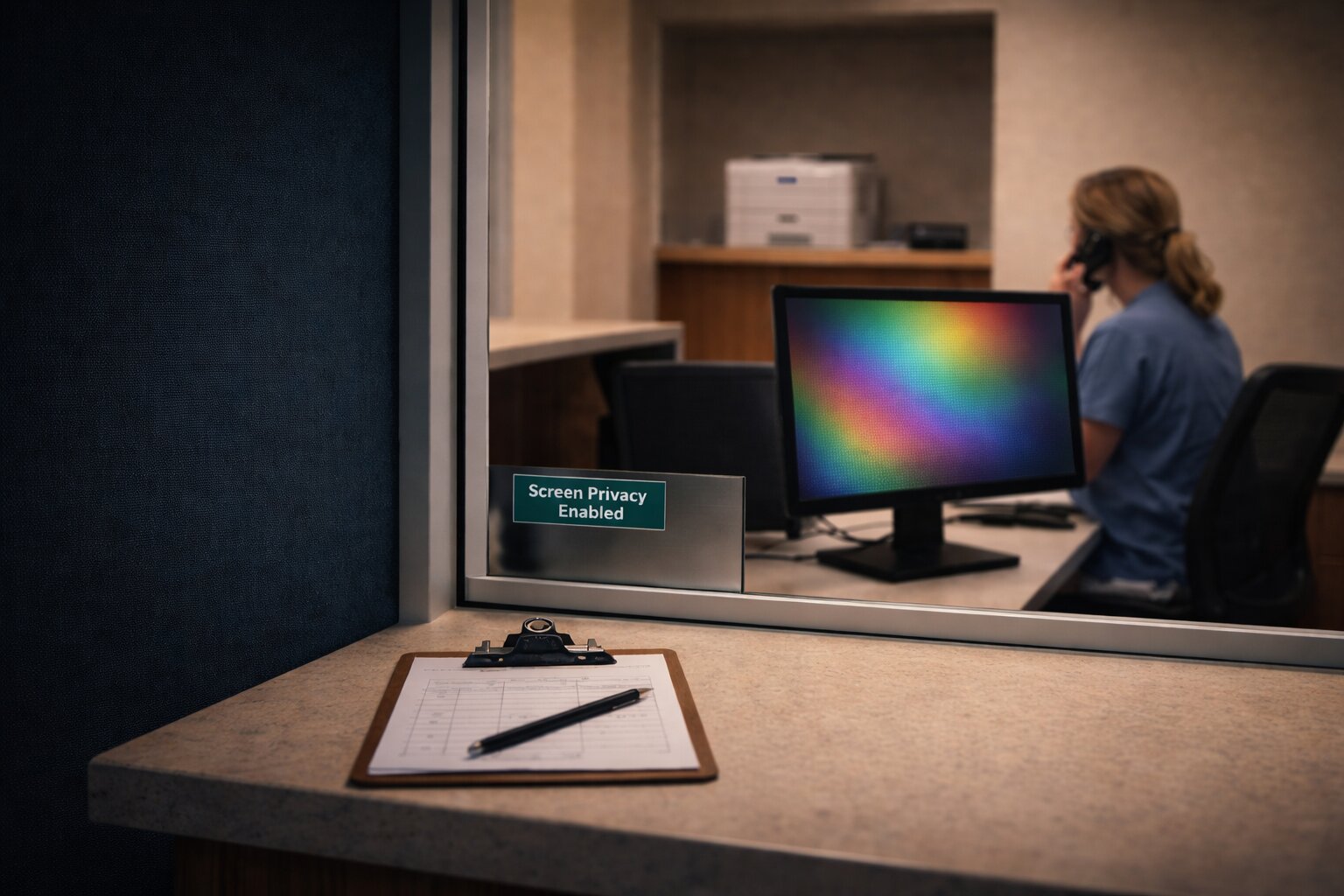
A patient glimpsing another patient's records on a screen is a privacy violation that didn't need to happen. We make sure every workstation in your practice is positioned and configured to prevent it.
Front Desk & Reception Privacy
Paper sign-in sheets and visible monitors at check-in are among the most common HIPAA complaints patients file. We redesign your front desk workflow so nothing is exposed to the waiting room.
Printer/Fax/Copier Security
Uncollected printouts in a hallway or a returned copier with patient data on the hard drive are both reportable incidents. We secure your output devices and manage drive sanitization at lease end.
Server Room Physical Security
An unlocked server room means anyone, cleaning crew, visitors, or staff, can physically access your patient data. We make sure the room is secured, monitored, and protected against both intrusion and environmental failures.
See how your practice measures up
These are just some of the areas covered in our comprehensive practice assessment.
Schedule Your Free AssessmentQuestions Practices Actually Ask
Is a paper sign-in sheet at the front desk really a HIPAA problem?
It can be, if other patients can read names on it. It is one of the most commonly filed patient privacy complaints precisely because it feels harmless. The fix is usually simple: a covered sign-in method or a digital check-in that never exposes one patient's name to the next.
What do auditors actually check for physical safeguards versus cybersecurity?
Cybersecurity covers your network and systems. Physical safeguards cover what a person standing in your office can see or access: screens visible from the waiting room, unattended printouts, an unlocked server room. Both are required under HIPAA, and auditors check both.
Do we need to worry about our office copier or fax machine?
Yes. Many copiers and multifunction printers store scanned documents on an internal hard drive, and a returned lease unit with patient data still on it is a real, documented breach source. We manage drive sanitization at lease end and secure the devices while you use them.
We're a single-provider practice, does this level of physical security really apply to us?
HIPAA does not exempt small practices, and in a small office, physical exposure is often worse, not better, one shared front desk, one shared workstation, less separation between clinical and admin areas. We size the fix to your actual footprint, not a large-practice template.
How Does Your Practice's Technology Stack Up?
Our comprehensive assessment covers every system that touches patient care. No cost, no obligation, just clarity on where you stand.
Schedule Your Free AssessmentContent on this site is for informational purposes only and does not constitute legal or compliance advice. HIPAA requirements vary by organization type and size. Consult a qualified HIPAA compliance officer for guidance specific to your practice. SE Technical's HIPAA-aligned IT services are informed by the Compliancy Group certification framework.