
Medical IT Services
Technology That Moves Patients Through Your Practice
From digital intake to exam room technology to checkout, every patient touchpoint is an opportunity to save time, reduce errors, and increase revenue.
Every Minute a Patient Waits Costs You
Patient flow isn't just a convenience issue, it's a revenue issue. A practice that moves patients efficiently sees more patients per day, collects more at the point of care, has higher patient satisfaction scores, and gets fewer negative reviews.
The technology that supports patient flow touches every part of your practice, from the moment someone walks in the door to the follow-up reminder they get the next week. Problems at any step create bottlenecks that ripple through the rest of your day.
We identify where technology is slowing your team down and implement solutions that your staff actually wants to use, because the best system in the world doesn't help if nobody uses it.
We break patient flow into three phases, arrival, in-room, and departure, because each has a different set of failure points. A great intake process doesn't fix a slow checkout, and exam room technology that saves a provider time doesn't help if the appointment was never confirmed in the first place. The nine categories below cover all three phases.
Patient Flow, Arrival
From the moment a patient walks in, technology should accelerate their experience, not slow it down.
Patient Intake & Consent
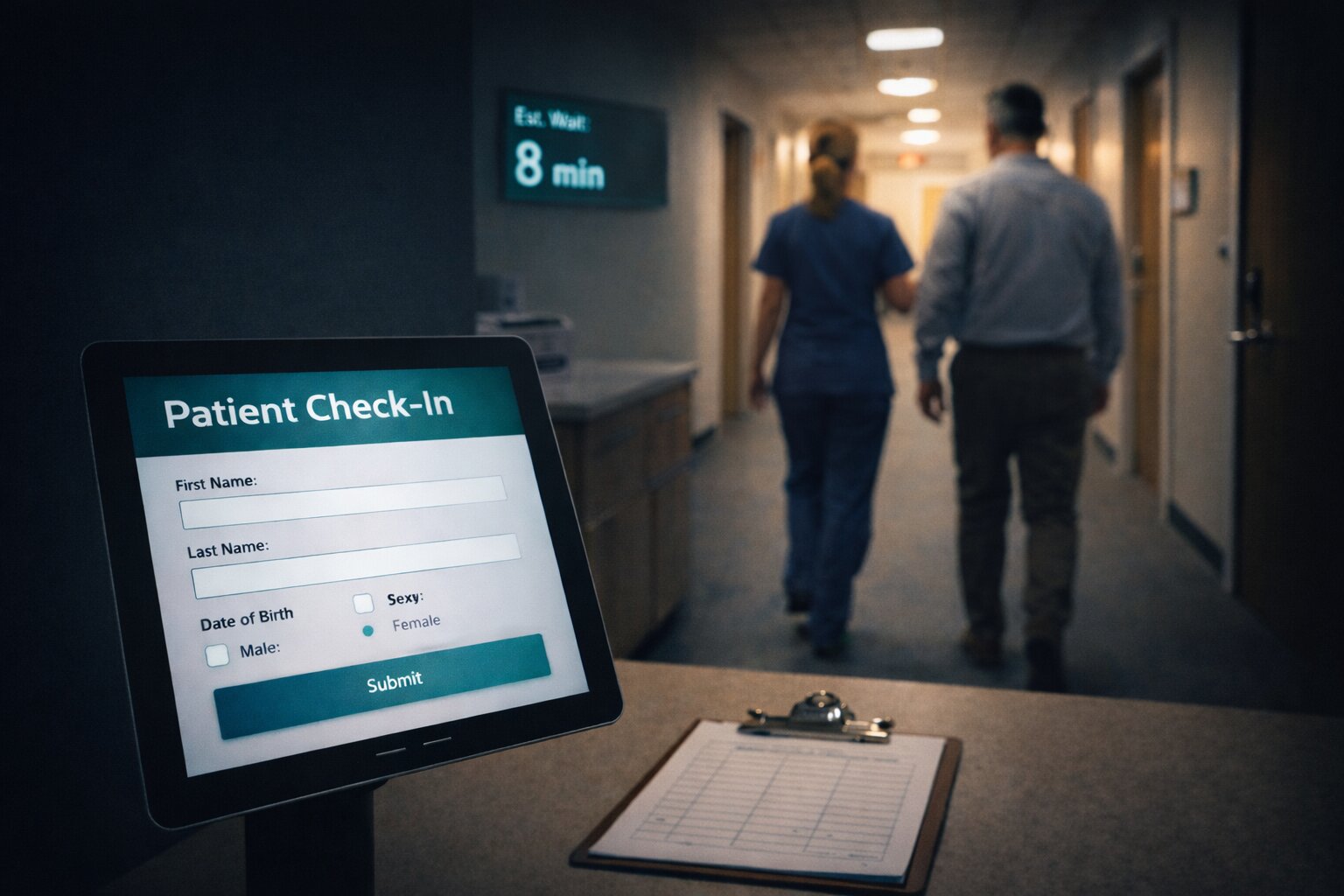
Paper clipboards add 10-15 minutes per visit and force staff to re-enter every field by hand. We implement digital intake that flows directly into your EHR, patients fill forms before they arrive.
Waiting Room Experience
Long, unacknowledged waits are the top driver of negative patient reviews online. We deploy wait-time visibility and workflow tracking to identify bottlenecks before they affect your reputation.
Patient Flow, In-Room
Exam room technology that keeps providers focused on patients, not fighting computers.
In-Room Appointment Scheduling
Telling patients to "call the front desk" for follow-ups drops compliance by 30-40%, and every missed follow-up is lost revenue. We integrate scheduling into the exam room so appointments are booked before the patient stands up.
In-Room Payment Collection
Every patient who leaves without paying costs $15-25 in billing follow-up, and point-of-care collection improves rates by over 50%. We deploy integrated payment terminals so collection happens naturally during the visit.
Clinical Data Capture
Providers charting hours after visits from memory lose 2-3 hours per day and produce less accurate records. We configure specialty templates and dictation tools so documentation is finished before the next patient.
Exam Room Technology
A provider leaving the exam room to find a computer breaks patient engagement and adds 5-10 minutes per visit. We equip every room with fast-login workstations and integrated peripherals so the technology disappears into the workflow.
Patient Flow, Departure
Smooth checkout, timely reminders, and portal access keep patients coming back.
Checkout Process
A slow checkout creates a negative last impression and backs up your entire schedule. We streamline the workflow so payment, scheduling, and referrals happen in one seamless stop.
Appointment Reminders
Manual reminder calls consume hours of staff time daily, and practices without automation see no-show rates 2-3x higher. We implement two-way text reminders so patients confirm with a tap and your staff reclaims their day.
After-Visit Summary & Portal
A dormant patient portal means patients call your office for every result and every question. We configure automatic summaries and portal access so patients help themselves, and your staff fields fewer calls.
See how your practice measures up
These are just some of the areas covered in our comprehensive practice assessment.
Schedule Your Free AssessmentQuestions Practices Actually Ask
Will patients actually use digital intake, or do they just want a clipboard?
Adoption is generally high when the digital option is genuinely faster, filling forms on a phone before an appointment beats filling the same forms twice in a waiting room. We still keep a paper fallback available for patients who prefer it, digital intake is an option, not a requirement.
Does automated appointment reminders really reduce no-shows that much?
Two-way text reminders that let a patient confirm or reschedule with a tap consistently outperform a one-way phone call reminder, because the patient can act on it immediately instead of needing to call back during business hours.
Is this worth it for a single-provider or small practice?
Patient flow problems scale down, not away, a single provider still loses time to a slow checkout or an unconfirmed appointment, just with less staff to absorb it. We size the fix to a small practice, not a large group's budget.
Where should we start if we can only fix one thing right now?
Whichever step in your specific workflow is creating the longest bottleneck, and that is different for every practice. Our assessment identifies your actual bottleneck instead of assuming it is the same one every practice has.
How Does Your Practice's Technology Stack Up?
Our comprehensive assessment covers every system that touches patient care. No cost, no obligation, just clarity on where you stand.
Schedule Your Free AssessmentContent on this site is for informational purposes only and does not constitute legal or compliance advice. HIPAA requirements vary by organization type and size. Consult a qualified HIPAA compliance officer for guidance specific to your practice. SE Technical's HIPAA-aligned IT services are informed by the Compliancy Group certification framework.