
Knowing When to Reach Out: The Signal-Grounded Outreach Engine We Built for Ourselves
The week a prospect changes jobs, expands, or asks for what you sell, our AI drafts an email grounded in that exact event, cited to the source, to send in one click.
Late one night, someone on a local subreddit typed out a small frustration: “Our IT company takes days to call us back, anyone have a managed IT provider near Gwinnett they actually like?” By the next morning, a reply was already written and waiting on a salesperson’s screen, quoting that exact post, linking to it, one click from sent. Nobody had bought a list. Nobody had written a template. Something had just been watching, recognized the moment, and drafted the response.
That’s the opposite of how outreach usually works. The old playbook, buy a list, write one generic message, blast it to a few thousand strangers, hope, barely clears the noise floor anymore. Spam filters punish bulk sending, and the people on the receiving end can smell a mail-merge from the subject line. The problem was never really the message, though. It was that the timing was random. Nobody wants to hear from a new vendor on a Tuesday for no reason, but a short, specific note that lands the same week someone changed jobs, opened a second location, or publicly asked for exactly what you sell doesn’t read like a pitch at all. It reads like someone paying attention.
So the win isn’t a million emails. It’s a few dozen right ones, sent within hours of a real moment, about something the recipient genuinely cares about right now. An email that mentions exactly the thing they posted last week, and feels handcrafted because, in every way that matters, it is. A salesperson can work a queue like that in a focused half-hour a day instead of a morning of dialing.
The trouble is that those moments are scattered across the open internet, they happen on no schedule, and a small team can’t possibly watch for all of them by hand. So we built an AI engine to do the watching. We pointed it at our own market, and it’s the companion that feeds the pre-visit briefs in the route planner we built for our field team. This is what it does, and why the design decisions matter more than the model.
The job: watch the world, surface the moment
Picture a sharp business-development assistant whose entire job is to read everything public and tap a rep on the shoulder: “Reach out to this person today, and here’s exactly why.” Not a thousand names. A short, ranked list of real moments, each one with a reason attached and a draft already written.
That’s the engine. Under the hood it runs the loop a diligent researcher would, just continuously and at machine speed:
- Watch. A steady stream of public signals flows in through a single intake, news, breach and ransomware feeds, job boards, and public posts, and new sources can be added without rebuilding the machine. We’ll be honest about the limits: no system catches every public mention, and the social-post coverage in particular finds some of the hand-raises out there, not all of them. It’s a net, not a dragnet.
- Understand. A local large language model reads each raw item and pulls out what actually matters, which company, which person, what happened, how time-sensitive it is. A press release or a forum thread becomes structured facts instead of a wall of text.
- Match. Each event is tied back to a real person in your CRM. A signal that doesn’t connect to anyone you track is set aside; one that lands on an existing relationship gets promoted.
- Decide and draft. For the moments worth acting on, the engine writes the outreach: a short subject line and a few sentences that open by referencing the specific thing that happened, then make a low-pressure ask. The draft arrives with its reasoning and a link to the source.
By the time a human looks, the research is done and the message is written. The only thing left is the part that should always belong to a person: judgment.
What should I do right now? The triage inbox
Volume isn’t the enemy of an outreach tool; undifferentiated volume is, a pile of forty maybe-interesting leads is just a different kind of overwhelm. So the first real design decision was that the engine has to answer one question every morning, what should I do right now?, at a glance.
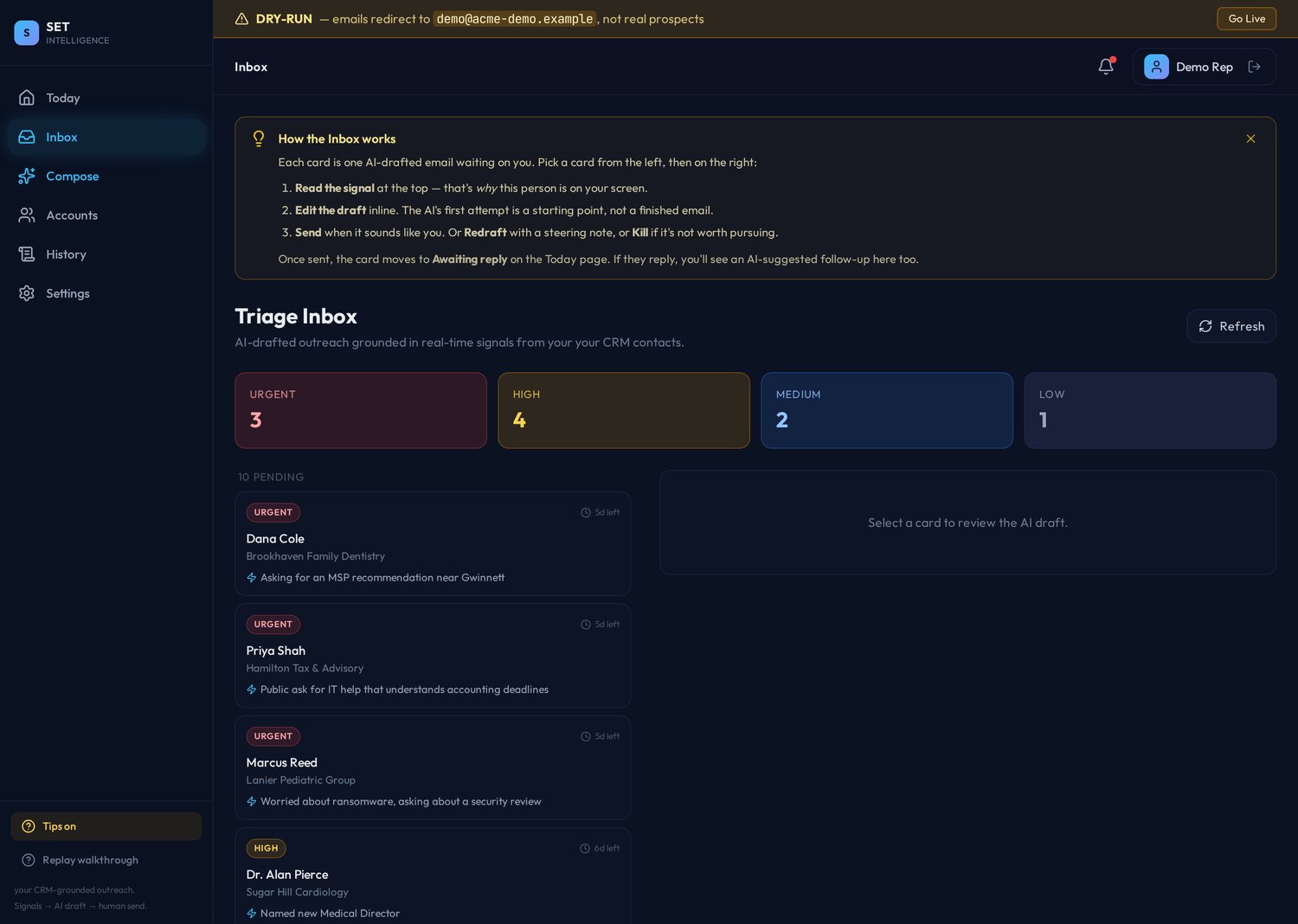
The inbox above is a real triage queue. Every card is one AI-drafted email waiting on a person, and the whole thing sorts by urgency. At the top sit the URGENT cards: explicit hand-raises, where someone has literally asked for a provider like you. In the screenshot, Dana Cole at Brookhaven Family Dentistry is asking for an MSP recommendation near Gwinnett; Priya Shah at Hamilton Tax & Advisory made a public ask for IT help that understands accounting deadlines. You don’t need a model to tell you those are worth a same-day reply, but you do need something watching the internet around the clock to catch them while they’re still warm.
Below the hand-raises come the HIGH-priority good-timing signals, strong reasons to reach out that aren’t someone waving a hand. A company that just hired a new leader is the classic one: new leaders re-evaluate vendors in their first few months, which is why Dr. Alan Pierce’s practice naming a new Medical Director surfaces as a high-priority card. A company that’s expanding is another; growth strains whatever IT they have. Further down sit lower-priority mentions worth knowing about but not worth dropping everything for. The rep works the top of the list and stops when the good moments run out, a focused half-hour on what matters, not an hour of triage first.
Every claim cites its source
The fastest way to lose trust in an AI is to let it assert things it can’t back up. One confidently wrong “I saw that you just…” and a rep will never trust the queue again. So the engine is built around a hard rule: every draft is grounded in a real signal, and every signal links to its source.
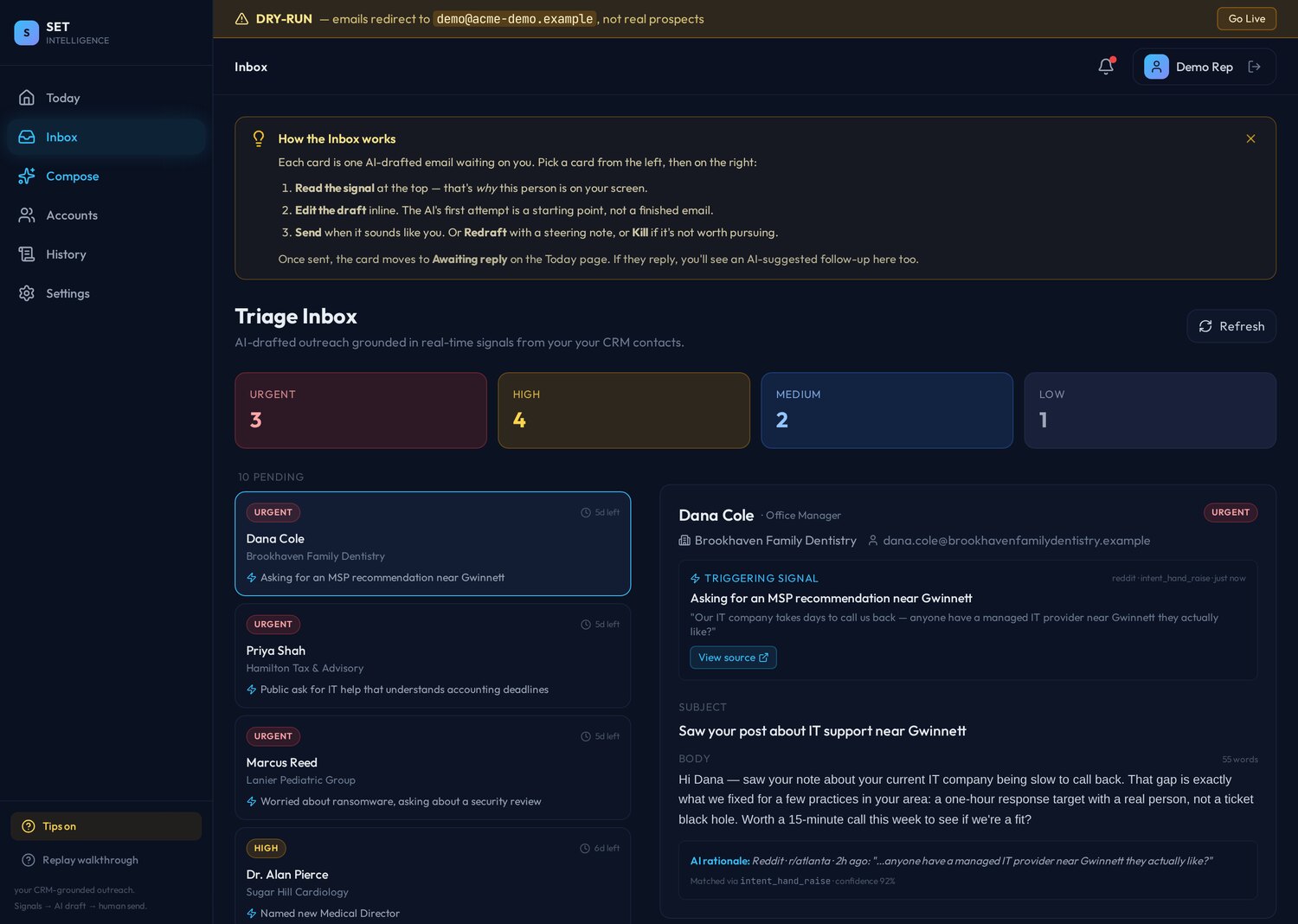
Open a card and the whole chain of reasoning is laid bare. At the top is the triggering signal, the actual public post, here someone complaining that their IT company takes days to call back and asking whether anyone has a managed provider near Gwinnett they like, with a view-source link that opens the original. Below it, the subject and body the AI wrote in response: a few sentences that reference the slow-callback complaint specifically and offer a short call. And at the bottom, the citation and a confidence score on the match, so the rep sees not just what the AI wrote but why it thinks this person belongs on the screen at all.
That traceability is how trust gets built. The rep is never approving a black box; they’re approving a real, verifiable moment they can read for themselves before a word goes out, and nobody sends a message built on a hallucinated fact, because the fact is sitting right there, one click away, ready to be checked.
The tasteful play: knowing when not to reach out
This is the design decision that separated the tool from a spam cannon, and it’s the one we’re proudest of. Restraint is a feature.
Consider a company that’s just been hit by ransomware. It lights up the breach feeds, and the crude instinct is to pounce, “looks like you could use a new IT provider.” Don’t. It’s tone-deaf, and people remember exactly who emailed them on the worst day of their quarter. So the engine does the opposite: when it sees an active incident, it tags the victim, holds them off the queue entirely, and schedules a quiet check-in roughly ninety days out, when the dust has settled and they’re privately shopping for a provider who didn’t try to capitalize on their bad week. Same signal, completely different timing, and the timing is the whole game.
It’s worth drawing the line clearly, because the inbox shows both sides. A company that is itself worried and asking about a security review, like Marcus Reed’s pediatric group in the screenshot, is a hand-raise, a same-day card. A company actively under attack is a victim, a card the engine deliberately puts to sleep for three months. Telling those two apart, and acting differently on each, is exactly the kind of taste you’d hope a good rep would have. We taught it to the system.
The AI drafts; the human decides
We’re deliberate about the division of labor, because it’s the line that makes this trustworthy: the drafts are genuinely AI-written; the judgment is entirely human. The engine handles the grinding middle, watching, reading, matching, and writing a credible first attempt. It never sends anything on its own.
When a rep opens a card they do one of three things. They send it, usually after tweaking a word or two so it sounds like them instead of like a machine, which takes seconds because the draft is already specific and grounded. They redraft it with a quick steering note if the angle’s off. Or they kill it. Killing is a first-class action here, not an afterthought, because the reason a rep kills a card is some of the most valuable signal in the system: “Wrong industry.” “We don’t serve that area.” “Not a real buying signal.” Each one teaches the engine what this rep considers noise, and the queue gets sharper over time, quieter and more accurate the more it’s used, which is precisely backwards from how most automated outreach decays into spam.
That’s the difference between a tool and a teammate, and it’s why we describe these systems as AI virtual employees rather than features. They own an outcome, they exercise restraint, they learn from a “no,” and they answer to a person.
Test before you automate
Outward-facing automation earns trust by being impossible to fire by accident. So the engine ships in a safe mode by default: every send is redirected to a test address and clearly badged as a dry run, that’s the banner across the top of both screenshots above, routing mail to a demo inbox instead of real prospects. You can watch it find signals and draft emails for as long as you like, days if you want, while nothing it produces ever touches a real inbox.
Going live is a deliberate act, not a stray click. It takes a typed confirmation to flip from dry-run to real sending, and every send, reply, and decision is logged along the way. For anything that reaches out to real people on your behalf, that combination, a safe default, a conscious switch to turn it on, and a complete audit trail, isn’t a nice-to-have. It’s the entire reason you can let the thing run.
And it stays on the right side of the rules
For a relationship business, your reputation is the asset, so the engine is built to protect it, not spend it. It watches only public signals: the same news, posts, and disclosures anyone could read, never private data. Every message is one-to-one, a single person, a single real reason, written and approved individually, not a bulk blast dressed up as personalization. Every email carries a working unsubscribe link and the physical mailing address the law requires, and the moment someone opts out the engine becomes structurally unable to email them again, that’s enforced in the system, not left to a setting someone forgets to honor. The outcome is outreach that’s compliant by construction, and that a careful owner can put their own name behind.
It runs on AI you own
There’s a reason this capability belongs inside your business rather than on a generic cloud service: the raw material is your contact list and your relationships, some of the most sensitive data a company has. Pumping your entire CRM through a third-party AI to get it sorted is exactly the trade you don’t want to make.
You don’t have to. The extraction and the drafting both run on a local AI server, a private model on hardware you own, sitting inside your own network. Your contacts, your pipeline, and the messages your team is about to send never leave the building, and there’s no per-message bill that grows every time the system gets more useful. You get the intelligence without renting out your relationships. That’s the pattern behind everything we do as a Managed Intelligence Provider: AI layered on top of dependable, owned infrastructure, not bolted onto someone else’s.
The CRM stays the spine
One more decision that keeps this sane long-term: the engine augments your CRM instead of becoming a second one to maintain. Every draft, send, and reply traces back to a contact record you already have, and every write is logged against it, no parallel database drifting out of sync, no “wait, which system is right?” Your CRM stays the source of truth for your contacts; the engine just surfaces the right ones at the right moment, with the right thing to say. It meets your stack where it is, too: it connects to the CRM you already run, HubSpot, Salesforce, Zoho, or something else, through a connector we build for your system, so there’s no second database to adopt. And it isn’t a per-seat subscription that bills forever, it’s a private engine we stand up and manage for you, running on a modest server inside your own network. You own the capability instead of renting it by the message.
We built it for ourselves, and it generalizes
We didn’t see this in a vendor deck and turn around to resell it. We built it to solve our own outreach problem and have been running it against our own market, the same way we built our field-team route planner for our own windshield time. That’s the only honest way to recommend a thing: operate it yourself first, where it has to survive sources going quiet, names that match two companies, and signals that looked urgent and turned out to be nothing.
And the pattern is broadly useful. Anyone doing relationship-based B2B outreach has the same core problem: the moments when a prospect is most ready to hear from you are already happening somewhere in the public record, and nobody’s watching for them. A contractor cares about permits and projects breaking ground; a professional firm cares about leadership changes; a supplier cares about who just won a contract that means new demand. It doesn’t even have to be new business, point the same engine at your existing customers and it becomes a retention-and-upsell timing tool, nudging you to check in exactly when an account is growing, reorganizing, or showing strain.
The principle never changes: watch for the real moments, ground every message in a verifiable one, triage by urgency, know when not to send, keep a human in charge, and run it all on AI you own.
Want to see what your team’s queue would look like? Tell us your market and we’ll show you the kinds of moments already slipping past unnoticed. Then, in a free, no-obligation business assessment, we’ll map whether a private outreach engine, drafts by the AI, judgment by your people, is the right first step for how you find new business.
Frequently asked questions
Does the AI send the emails on its own, or do I approve each one first?
It never sends anything on its own. Every draft waits for a person, who can send it (often after tweaking a word or two), redraft it with a quick steering note, or kill it. The drafts are AI-written, but the judgment stays entirely yours, you approve each message individually before it goes out.
How does the AI decide who to reach out to and when?
It continuously watches public signals, news, breach and ransomware feeds, job boards, and public posts, through a single intake. A local model reads each item to pull out who's involved, what happened, and how time-sensitive it is, then ties it to a person in your CRM. Worthwhile moments get a drafted email, ranked by urgency.
Does my CRM and contact data get sent to a third-party AI service?
No. Both the extraction and the drafting run on a local AI server, a private model on hardware you own, inside your own network, so your contacts, pipeline, and outgoing messages never leave the building. It connects to the CRM you already run, like HubSpot, Salesforce, or Zoho, through a connector built for your system.
What does the engine do when a company gets hit by ransomware or a breach?
It holds back. Instead of pouncing on a victim during an active incident, the engine tags them, keeps them off the queue entirely, and schedules a quiet check-in roughly ninety days out, once the dust has settled. A company that is itself asking about a security review, by contrast, is treated as a same-day hand-raise.
Knowing When to Reach Out: The Signal-Grounded Outreach Engine We Built for Ourselves
The week a prospect changes jobs, expands, or asks for what you sell, our AI drafts an email grounded in that exact event, cited to the source, to send in one click.
Late one night, someone on a local subreddit typed out a small frustration: “Our IT company takes days to call us back, anyone have a managed IT provider near Gwinnett they actually like?” By the next morning, a reply was already written and waiting on a salesperson’s screen, quoting that exact post, linking to it, one click from sent. Nobody had bought a list. Nobody had written a template. Something had just been watching, recognized the moment, and drafted the response.
That’s the opposite of how outreach usually works. The old playbook, buy a list, write one generic message, blast it to a few thousand strangers, hope, barely clears the noise floor anymore. Spam filters punish bulk sending, and the people on the receiving end can smell a mail-merge from the subject line. The problem was never really the message, though. It was that the timing was random. Nobody wants to hear from a new vendor on a Tuesday for no reason, but a short, specific note that lands the same week someone changed jobs, opened a second location, or publicly asked for exactly what you sell doesn’t read like a pitch at all. It reads like someone paying attention.
So the win isn’t a million emails. It’s a few dozen right ones, sent within hours of a real moment, about something the recipient genuinely cares about right now. An email that mentions exactly the thing they posted last week, and feels handcrafted because, in every way that matters, it is. A salesperson can work a queue like that in a focused half-hour a day instead of a morning of dialing.
The trouble is that those moments are scattered across the open internet, they happen on no schedule, and a small team can’t possibly watch for all of them by hand. So we built an AI engine to do the watching. We pointed it at our own market, and it’s the companion that feeds the pre-visit briefs in the route planner we built for our field team. This is what it does, and why the design decisions matter more than the model.
The job: watch the world, surface the moment
Picture a sharp business-development assistant whose entire job is to read everything public and tap a rep on the shoulder: “Reach out to this person today, and here’s exactly why.” Not a thousand names. A short, ranked list of real moments, each one with a reason attached and a draft already written.
That’s the engine. Under the hood it runs the loop a diligent researcher would, just continuously and at machine speed:
- Watch. A steady stream of public signals flows in through a single intake, news, breach and ransomware feeds, job boards, and public posts, and new sources can be added without rebuilding the machine. We’ll be honest about the limits: no system catches every public mention, and the social-post coverage in particular finds some of the hand-raises out there, not all of them. It’s a net, not a dragnet.
- Understand. A local large language model reads each raw item and pulls out what actually matters, which company, which person, what happened, how time-sensitive it is. A press release or a forum thread becomes structured facts instead of a wall of text.
- Match. Each event is tied back to a real person in your CRM. A signal that doesn’t connect to anyone you track is set aside; one that lands on an existing relationship gets promoted.
- Decide and draft. For the moments worth acting on, the engine writes the outreach: a short subject line and a few sentences that open by referencing the specific thing that happened, then make a low-pressure ask. The draft arrives with its reasoning and a link to the source.
By the time a human looks, the research is done and the message is written. The only thing left is the part that should always belong to a person: judgment.
What should I do right now? The triage inbox
Volume isn’t the enemy of an outreach tool; undifferentiated volume is, a pile of forty maybe-interesting leads is just a different kind of overwhelm. So the first real design decision was that the engine has to answer one question every morning, what should I do right now?, at a glance.
The inbox above is a real triage queue. Every card is one AI-drafted email waiting on a person, and the whole thing sorts by urgency. At the top sit the URGENT cards: explicit hand-raises, where someone has literally asked for a provider like you. In the screenshot, Dana Cole at Brookhaven Family Dentistry is asking for an MSP recommendation near Gwinnett; Priya Shah at Hamilton Tax & Advisory made a public ask for IT help that understands accounting deadlines. You don’t need a model to tell you those are worth a same-day reply, but you do need something watching the internet around the clock to catch them while they’re still warm.
Below the hand-raises come the HIGH-priority good-timing signals, strong reasons to reach out that aren’t someone waving a hand. A company that just hired a new leader is the classic one: new leaders re-evaluate vendors in their first few months, which is why Dr. Alan Pierce’s practice naming a new Medical Director surfaces as a high-priority card. A company that’s expanding is another; growth strains whatever IT they have. Further down sit lower-priority mentions worth knowing about but not worth dropping everything for. The rep works the top of the list and stops when the good moments run out, a focused half-hour on what matters, not an hour of triage first.
Every claim cites its source
The fastest way to lose trust in an AI is to let it assert things it can’t back up. One confidently wrong “I saw that you just…” and a rep will never trust the queue again. So the engine is built around a hard rule: every draft is grounded in a real signal, and every signal links to its source.
Open a card and the whole chain of reasoning is laid bare. At the top is the triggering signal, the actual public post, here someone complaining that their IT company takes days to call back and asking whether anyone has a managed provider near Gwinnett they like, with a view-source link that opens the original. Below it, the subject and body the AI wrote in response: a few sentences that reference the slow-callback complaint specifically and offer a short call. And at the bottom, the citation and a confidence score on the match, so the rep sees not just what the AI wrote but why it thinks this person belongs on the screen at all.
That traceability is how trust gets built. The rep is never approving a black box; they’re approving a real, verifiable moment they can read for themselves before a word goes out, and nobody sends a message built on a hallucinated fact, because the fact is sitting right there, one click away, ready to be checked.
The tasteful play: knowing when not to reach out
This is the design decision that separated the tool from a spam cannon, and it’s the one we’re proudest of. Restraint is a feature.
Consider a company that’s just been hit by ransomware. It lights up the breach feeds, and the crude instinct is to pounce, “looks like you could use a new IT provider.” Don’t. It’s tone-deaf, and people remember exactly who emailed them on the worst day of their quarter. So the engine does the opposite: when it sees an active incident, it tags the victim, holds them off the queue entirely, and schedules a quiet check-in roughly ninety days out, when the dust has settled and they’re privately shopping for a provider who didn’t try to capitalize on their bad week. Same signal, completely different timing, and the timing is the whole game.
It’s worth drawing the line clearly, because the inbox shows both sides. A company that is itself worried and asking about a security review, like Marcus Reed’s pediatric group in the screenshot, is a hand-raise, a same-day card. A company actively under attack is a victim, a card the engine deliberately puts to sleep for three months. Telling those two apart, and acting differently on each, is exactly the kind of taste you’d hope a good rep would have. We taught it to the system.
The AI drafts; the human decides
We’re deliberate about the division of labor, because it’s the line that makes this trustworthy: the drafts are genuinely AI-written; the judgment is entirely human. The engine handles the grinding middle, watching, reading, matching, and writing a credible first attempt. It never sends anything on its own.
When a rep opens a card they do one of three things. They send it, usually after tweaking a word or two so it sounds like them instead of like a machine, which takes seconds because the draft is already specific and grounded. They redraft it with a quick steering note if the angle’s off. Or they kill it. Killing is a first-class action here, not an afterthought, because the reason a rep kills a card is some of the most valuable signal in the system: “Wrong industry.” “We don’t serve that area.” “Not a real buying signal.” Each one teaches the engine what this rep considers noise, and the queue gets sharper over time, quieter and more accurate the more it’s used, which is precisely backwards from how most automated outreach decays into spam.
That’s the difference between a tool and a teammate, and it’s why we describe these systems as AI virtual employees rather than features. They own an outcome, they exercise restraint, they learn from a “no,” and they answer to a person.
Test before you automate
Outward-facing automation earns trust by being impossible to fire by accident. So the engine ships in a safe mode by default: every send is redirected to a test address and clearly badged as a dry run, that’s the banner across the top of both screenshots above, routing mail to a demo inbox instead of real prospects. You can watch it find signals and draft emails for as long as you like, days if you want, while nothing it produces ever touches a real inbox.
Going live is a deliberate act, not a stray click. It takes a typed confirmation to flip from dry-run to real sending, and every send, reply, and decision is logged along the way. For anything that reaches out to real people on your behalf, that combination, a safe default, a conscious switch to turn it on, and a complete audit trail, isn’t a nice-to-have. It’s the entire reason you can let the thing run.
And it stays on the right side of the rules
For a relationship business, your reputation is the asset, so the engine is built to protect it, not spend it. It watches only public signals: the same news, posts, and disclosures anyone could read, never private data. Every message is one-to-one, a single person, a single real reason, written and approved individually, not a bulk blast dressed up as personalization. Every email carries a working unsubscribe link and the physical mailing address the law requires, and the moment someone opts out the engine becomes structurally unable to email them again, that’s enforced in the system, not left to a setting someone forgets to honor. The outcome is outreach that’s compliant by construction, and that a careful owner can put their own name behind.
It runs on AI you own
There’s a reason this capability belongs inside your business rather than on a generic cloud service: the raw material is your contact list and your relationships, some of the most sensitive data a company has. Pumping your entire CRM through a third-party AI to get it sorted is exactly the trade you don’t want to make.
You don’t have to. The extraction and the drafting both run on a local AI server, a private model on hardware you own, sitting inside your own network. Your contacts, your pipeline, and the messages your team is about to send never leave the building, and there’s no per-message bill that grows every time the system gets more useful. You get the intelligence without renting out your relationships. That’s the pattern behind everything we do as a Managed Intelligence Provider: AI layered on top of dependable, owned infrastructure, not bolted onto someone else’s.
The CRM stays the spine
One more decision that keeps this sane long-term: the engine augments your CRM instead of becoming a second one to maintain. Every draft, send, and reply traces back to a contact record you already have, and every write is logged against it, no parallel database drifting out of sync, no “wait, which system is right?” Your CRM stays the source of truth for your contacts; the engine just surfaces the right ones at the right moment, with the right thing to say. It meets your stack where it is, too: it connects to the CRM you already run, HubSpot, Salesforce, Zoho, or something else, through a connector we build for your system, so there’s no second database to adopt. And it isn’t a per-seat subscription that bills forever, it’s a private engine we stand up and manage for you, running on a modest server inside your own network. You own the capability instead of renting it by the message.
We built it for ourselves, and it generalizes
We didn’t see this in a vendor deck and turn around to resell it. We built it to solve our own outreach problem and have been running it against our own market, the same way we built our field-team route planner for our own windshield time. That’s the only honest way to recommend a thing: operate it yourself first, where it has to survive sources going quiet, names that match two companies, and signals that looked urgent and turned out to be nothing.
And the pattern is broadly useful. Anyone doing relationship-based B2B outreach has the same core problem: the moments when a prospect is most ready to hear from you are already happening somewhere in the public record, and nobody’s watching for them. A contractor cares about permits and projects breaking ground; a professional firm cares about leadership changes; a supplier cares about who just won a contract that means new demand. It doesn’t even have to be new business, point the same engine at your existing customers and it becomes a retention-and-upsell timing tool, nudging you to check in exactly when an account is growing, reorganizing, or showing strain.
The principle never changes: watch for the real moments, ground every message in a verifiable one, triage by urgency, know when not to send, keep a human in charge, and run it all on AI you own.
Want to see what your team’s queue would look like? Tell us your market and we’ll show you the kinds of moments already slipping past unnoticed. Then, in a free, no-obligation business assessment, we’ll map whether a private outreach engine, drafts by the AI, judgment by your people, is the right first step for how you find new business.
Frequently asked questions
Does the AI send the emails on its own, or do I approve each one first?
It never sends anything on its own. Every draft waits for a person, who can send it (often after tweaking a word or two), redraft it with a quick steering note, or kill it. The drafts are AI-written, but the judgment stays entirely yours, you approve each message individually before it goes out.
How does the AI decide who to reach out to and when?
It continuously watches public signals, news, breach and ransomware feeds, job boards, and public posts, through a single intake. A local model reads each item to pull out who's involved, what happened, and how time-sensitive it is, then ties it to a person in your CRM. Worthwhile moments get a drafted email, ranked by urgency.
Does my CRM and contact data get sent to a third-party AI service?
No. Both the extraction and the drafting run on a local AI server, a private model on hardware you own, inside your own network, so your contacts, pipeline, and outgoing messages never leave the building. It connects to the CRM you already run, like HubSpot, Salesforce, or Zoho, through a connector built for your system.
What does the engine do when a company gets hit by ransomware or a breach?
It holds back. Instead of pouncing on a victim during an active incident, the engine tags them, keeps them off the queue entirely, and schedules a quiet check-in roughly ninety days out, once the dust has settled. A company that is itself asking about a security review, by contrast, is treated as a same-day hand-raise.